Marketers have more data than they ever dreamed of in 2026. In fact, according to DigitalApplied, the average monthly data stack is 47 TB for enterprise marketing.
That’s a wild amount of data. And that’s why marketers are killing it in 2026, right? Right?!
Despite having access to more campaign data than ever before, so many brands are still leaving significant advertising performance on the table.
Our internal data shows that non-optimised campaigns waste an average of £16,000 per £100k of media spend.
The problem isn't, clearly, a lack of data. It's disorganised data that makes in-flight ad optimisation impossible and scaling ad campaigns a drain on resources.
Most marketing teams launch campaigns, monitor dashboards and review performance once campaigns have finished. But by then, your budget has already been spent, and opportunities to improve results have been lost.
We know that brands achieving consistently higher campaign performance aren't necessarily spending more. They’re prioritising ad optimisation throughout the campaign lifecycle, using data to make in-flight changes to ads.
This approach allows marketers to continuously improve campaigns while they're still running, helping teams optimise more campaigns, make better decisions and ultimately scale their advertising performance.
What Is In-Flight Ad Optimisation?
In-flight optimisation is the process of making strategic changes to digital advertising campaigns while they are actively running.
Rather than waiting until a campaign has finished, you use real-time performance data to improve results throughout the campaign lifecycle.
This might include:
- Pausing underperforming ads.
- Increasing budget for high-performing audiences.
- Refreshing creative to combat ad fatigue.
- Refining audience targeting.
- Updating calls to action.
- Adjusting bidding strategies.
- Optimising placements across channels.
The goal isn't simply to react to data at the end of the campaign, but to use live insights to improve campaign performance before your budget is wasted.
Scaling Ad Optimisation Is Your Competitive Advantage
Running digital campaigns is a time-consuming business for marketers, who are often juggling multiple campaigns at once.
Right now, you might be responsible for dozens, or even hundreds, running simultaneously across Google Ads, Meta, LinkedIn, TikTok, retail media networks and programmatic platforms.
And every campaign swamps you in thousands of performance signals every day. Without a scalable approach to ad optimisation, keeping up can feel impossible.
You become trapped in a cycle of:
- reviewing dashboards
- chasing performance issues
- reporting on results
- reacting to problems once the campaign has finished
Amidst this overwhelm, many marketers will feel the familiar sense that, despite the increasing demands to grow results, investment in their team remains low.
With the average size of an enterprise marketing analytics team sitting at 7.3 people, the number of campaigns often increases faster than most marketing teams can manually optimise them. And this means losses.
That’s where in-flight optimisation becomes indispensable because it does two essential things.
1. Improves your campaign performance
2. Makes ad optimisation scalable across your entire media portfolio without adding pressure to your team
The Cost Of Ignoring In-Flight Optimisation
Every day you let an underperforming campaign continue is another day of losing budget that could be better spent elsewhere.
If you’re only discovering what worked (or what didn’t) after the campaign has finished, you’re in danger of wasting your budget and having a hard time proving ROI to your stakeholders or senior leadership team.
Imagine a four-week campaign where one of your creative assets begins to tire after the first week, but you have no idea until the end of the campaign, and you also don’t know why it didn’t perform.
That’s a tough spot to be in. But one that’s achingly familiar for so many marketers.
Engagement declines + click-through rates fall = cost per acquisition increases.
If you don’t replace that creative before the campaign ends, three weeks of your budget have been spent delivering an asset that’s done nothing.
This is also true for your audience.
Real-time reporting may show that one audience segment is converting at half the cost of another. But if you do nothing? You’ll continue investing in lacklustre audiences while stronger-performing ones go unnoticed until it’s too late.
“Surprisingly, the best-performing territory turned out not to be serve education, range, refreshment, or occasion. It was targeting “non-whiskey drinkers.”
These missed opportunities compound over time. And we don’t need to lecture you on the results (but we will…):
- Higher acquisition costs
- Lower conversion rates
- Reduced return on ad spend
- More wasted media spend
- Lower overall campaign profitability
- Stress levels through the roof
In-flight optimisation helps you prevent these losses before they happen and gives you more control over your campaign success.
What Stops Marketers From Scaling Ad Optimisation
You’re probably thinking, “What doesn’t?!” after reading all this.
You know how important ad optimisation is. But making optimisation repeatable across every campaign? That’s the challenge. As campaign volumes increase, manual optimisation quickly becomes a monumental task.
Too Much Data, Not Enough Insight
Every campaign produces hundreds of metrics. Multiply that across dozens of live campaigns, and it’s easy to become overwhelmed.
Instead of identifying the highest-impact optimisation opportunities, teams spend their time reviewing dashboards. This slows decision making and prevents ad optimisation from scaling effectively.
Limited Time And Resources
Marketing teams are stretched. Budgets are too. As you’re under pressure to deliver more, across multiple platforms, your campaign complexity grows faster than you can keep up.
Fragmented Advertising Platforms
Campaign performance is rarely contained within a single platform. You’ve got data coming out of your ears, and it’s everywhere.
Each advertising platform provides different reporting structures, optimisation settings and performance metrics and your time is spent switching between dashboards rather than making informed optimisation decisions.
It’s not surprising that you’re not optimising, to be honest.
Uncertainty
Honestly? There’s no shame in admitting that you don’t know what the right decision is. How could you?
You’ve got all this data, but none of it telling you why something works (or doesn’t), so you genuinely don’t know what the answer is. And you can’t test with confidence either, because your data is vague and scattered.
Digital advertising optimisation is hard without the right tools and the right insight.
Doing nothing often feels like the safest option, but delaying optimisation will cost you more in the long run.
Creative And Approval Bottlenecks
Even when you identify an opportunity for optimisation, it can disappear if you don't act quickly enough.
Design requests, agency timelines and approval workflows become bottlenecks that prevent ad optimisation from happening at scale.
New creative might require:
- Design resources
- Agency support
- Brand approval
- Legal review
- Stakeholder sign-off
By the time changes are approved, your campaign may already be nearing completion.
Agility is essential to avoid these sticking points.
How In-Flight Optimisation Helps Marketers Scale Ad Optimisation
In-flight optimisation takes ad optimisation from reactive to proactive.
Rather than waiting until campaigns finish, you build optimisation into campaign management itself, giving you the power to influence outcomes.
That means:
- You spot issues earlier
- You prioritise budget on the highest-impact changes
- You can reallocate spending in the moment
- You reduce your non-working media costs and budget waste
- You improve your campaign performance continuously
“It’s the creative optimisation that truly is amazing, and it's absolutely necessary. That for me is what produces the actionable insights, and the deeper consumer learning that you get.”
- Julie Pender, Former Creative Content Manager at Havana Club
In-flight optimisation enables teams to optimise significantly more campaigns without proportionally increasing workload. And it’s replicable. Once you know what works, you’re more confident in your choices and more likely to see campaign success.
And it doesn't always require a major campaign overhaul.
Often, incremental improvements deliver impressive long-term gains.
You might:
- Increase your budget for high-performing campaigns
- Pause ads with poor conversion rates
- Replace creative that’s underperforming
- Adjust audience exclusions
- Update landing page messaging
- Refine bid strategies
- Test new creative variations (language, imagery, design, etc.)
Each optimisation might seem small, but together they can significantly improve your campaign performance throughout its lifecycle.
The earlier these changes are made, the greater the cumulative impact on results.
See how KFC did it.
Your Checklist For Improving Ad Campaign Performance
Here are our tips on how to improve your campaign performance:
- Monitor campaign performance throughout its lifecycle
- Define optimisation checkpoints before you launch
- Establish performance thresholds that trigger action
- Test creative regularly and iterate to reduce ad fatigue
- Reallocate media spend based on live performance
- Focus on improving return on ad spend rather than simply increasing spend
- Use real-time insights to guide optimisation decisions
Perfect from day one isn’t the goal. Continuous learning and optimisation is.
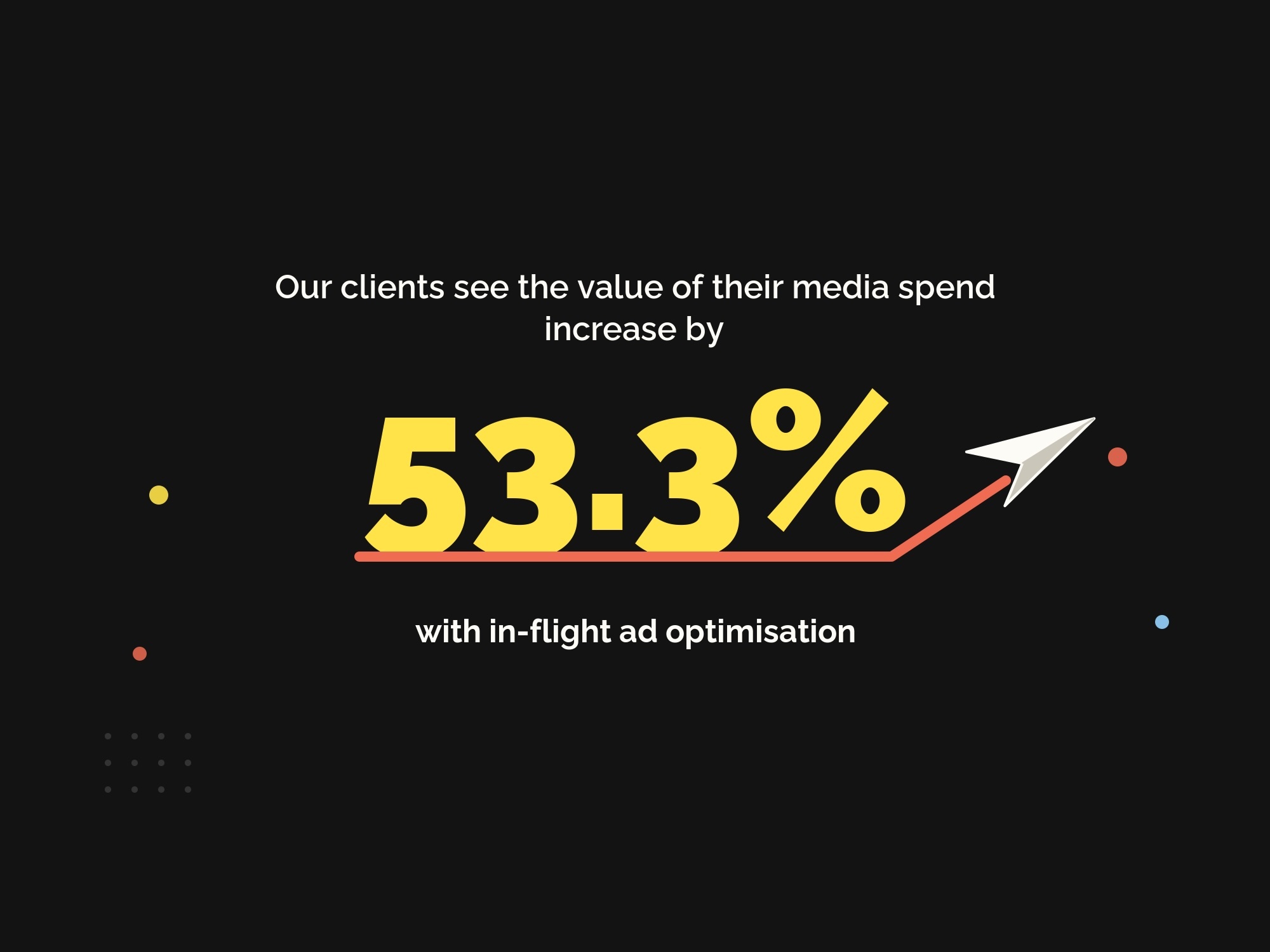
And it’s worth it. With this approach, our clients see the value of their media spend increase by 53.3%.
Let In-Flight Take Flight
You know what’s great about digital advertising? Campaigns don't have to remain fixed once they're live. Unlike a static billboard out in the wild, you can test, change and improve as much as you need to.
Having the ability to respond to your performance data, improve efficiency and maximise campaign performance while budgets are still being spent is a huge advantage. But it’s one that not many marketers are taking.
This is your opportunity to build ad optimisation into every stage of your campaign execution and see how it changes your results and your workload.
Give it a try.


 Automated Creative
 31 Jul 2026