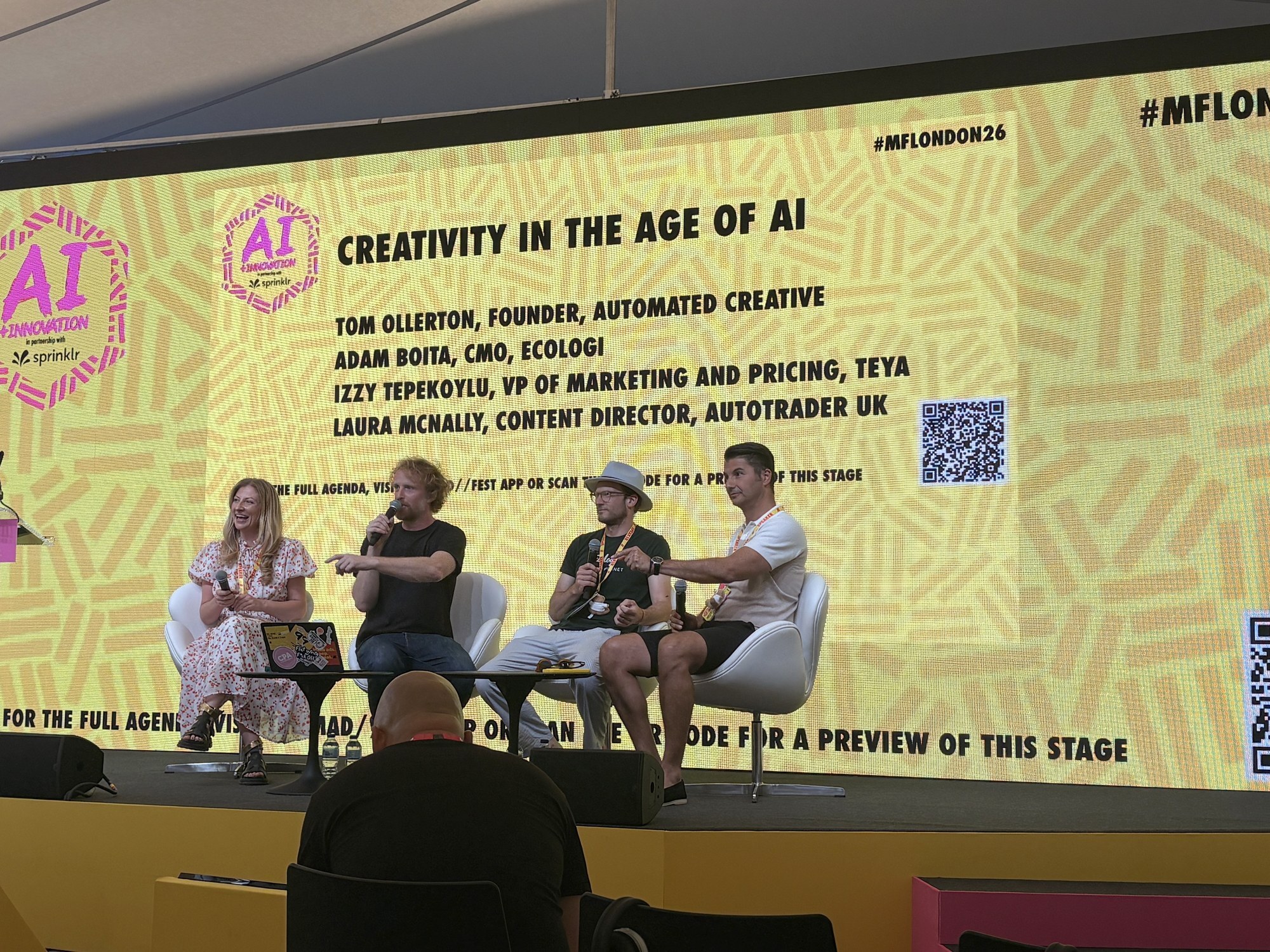
On a hot, July afternoon at MadFest in London, our founder, Tom Ollerton, sat down with Laura McNally, Content Director at Autotrader, Adam Boita, CMO at Ecologi, and Izzy Tepekoylu, VP of Marketing and Pricing at Teya.
The agenda?
A panel discussion around how organisations can embrace AI without losing the human qualities that make brands stand out. Key themes around trust, creativity and authenticity emerged as brands try to work out what AI is good for and what it isn’t.
Setting The Scene
Opening the session, Tom highlighted just how quickly AI is progressing. He referenced predictions that AI capable of outperforming humans at most economically valuable work carries around a 25% chance of becoming reality by the end of the decade.
At the same time, Anthropic has publicly called for a pause in AI development, concerned that AI could eventually become capable of improving itself faster than humans can oversee it…leading to all sorts of doomsday-esque predictions.
Tom also pointed to the increasing trust humans are placing in machines, citing research suggesting that one-third of Americans have already had a romantic relationship with an AI companion.
As dystopian (and quite frankly, I, Robot) as all this sounds, these are the realities facing businesses and marketers in 2026.
AI Is No Longer The Advantage; How You Use It Is
One message that united the panel was that AI itself isn’t the competitive advantage it once was.
"It's what you do with AI that counts," Tom explained, arguing that if one business can use AI to save time and reduce costs, its competitors can do exactly the same. The real opportunity is applying AI intelligently rather than simply adopting it.
The panel shared practical examples of how AI is already delivering value inside their organisations.
For Izzy Tepekoylu, AI has become deeply embedded across Teya's operations. One example is using AI as a brand tracker, monitoring the questions people ask AI platforms about Teya to better understand brand perception and emerging customer concerns.
"We use AI for everything every day," Izzy explained, "to see what works and what doesn't."
Rather than limiting experimentation, Izzy encourages his team to fully embrace AI to ensure they stay ahead of competitors.
"Without AI," he said, "our team simply wouldn't have the resources."
Laura McNally described how Autotrader is using AI to improve the value of long-form content. Instead of manually reviewing interviews or videos, AI identifies the strongest moments that can be turned into short-form clips, social media snippets or other engaging content.
"It's helping us find those moments much faster," she explained, allowing creative teams to focus their attention on refining the output rather than searching for highlights.
Meanwhile, Adam Boita shared how Ecologi uses AI to create greater consistency across departments. Rather than replacing people, AI helps align messaging, ensuring sales, marketing and other teams communicate with a consistent tone of voice and use the same data.
For Adam, AI is less about creating new ideas and more about ensuring everyone is working from the same foundations.
Humans Still Matter: Creativity And Trust
Despite their enthusiasm for AI, the panel repeatedly returned to one question: how do businesses prevent AI from damaging trust?
Tom highlighted what he believes is becoming a growing problem across advertising and marketing.
"We're confusing what is good with what looks good," he said, suggesting that polished AI-generated content often creates the illusion of quality without delivering genuine value.
We’ve all been there. Something that looked great on-screen and decidedly average in real life. For brands, this kind of customer experience damages reputations.
Take the recent exposé by the Financial Times, which reported that professional services firm KPMG had published a whitepaper on AI that included 40 fake citations.
The panellists agreed that while AI can produce content incredibly quickly, speed certainly doesn’t equal creativity or quality.
Laura argued that the quality of AI output depends entirely on the quality of human input.
"Average inputs create average outputs," she said.
For that reason, Autotrader deliberately protects human creativity through regular "AI-free sprints". During these sessions, employees are challenged to put AI aside, sometimes with little warning, and generate ideas themselves.
The approach forces teams to think independently before AI becomes part of the creative process.
"Without this,” Laura explained, "everything gets built from average."
Adam agreed, particularly when it comes to customer communications.
"We're in the trust business," he said.
While Ecologi uses AI extensively behind the scenes, Adam believes conversations with prospects and customers still require authentic human interaction.
"You can use AI," he said, "but you still have to be authentic."
Izzy offered perhaps the strongest counterpoint of the afternoon.
Rather than limiting AI, he believes organisations should push its capabilities as far as possible.
"My team is locked in to make sure we stay ahead,” he said.
For Izzy, the priority isn't restricting AI but understanding where it genuinely creates value. At Teya, the business is defining clear responsibilities for both people and AI, identifying which activities should remain human-led and which can be automated with confidence.
Once those boundaries are defined, the team sticks to them.
Efficiency, Environment and Culture
The discussion then broadened beyond productivity to examine AI's wider impact on society, sustainability and culture.
Adam highlighted the environmental implications of AI, noting the enormous volumes of water and energy consumed by AI infrastructure.
Rather than discouraging experimentation, he encouraged businesses to become more intentional.
"It comes down to input and output," he explained. AI should be used where it creates genuine value, not simply because it can.
He also pointed to initiatives such as AI for Good, arguing that the technology has enormous potential when applied to meaningful societal challenges.
The conversation then shifted to one of AI's current limitations: its inability to understand culture.
Adam questioned whether AI can genuinely connect the cultural dots in the same way experienced marketers can.
"Culture eats strategy," he reflected, "and maybe AI for breakfast."
While AI can analyse enormous datasets, he believes it still struggles to understand the nuances of human behaviour, shared experiences and cultural moments that shape effective marketing.
"It's an experience that's inaccessible to AI," he argued.
Laura agreed that authentic community engagement remains deeply human.
At Autotrader, community-generated outreach, including commenting on other people's posts and participating in conversations, is something AI cannot replicate with the same credibility or emotional intelligence.
The panel also discussed how marketing roles are evolving.
Adam suggested that marketers increasingly need to understand not only automation but also how to brief AI effectively without losing creative direction.
Izzy took a different view, arguing that businesses should prioritise hiring people with genuine expertise who know how to harness AI rather than fear it.
The Future For Brands: Powered By People and AI
Closing the session, the panel reflected on how AI is likely to reshape marketing over the coming years.
Despite differing opinions on how aggressively organisations should embrace AI, there was broad agreement that human judgement will remain essential.
AI can improve efficiency, analyse vast amounts of data and automate repetitive tasks at remarkable speed. But curiosity, creativity, empathy and cultural understanding continue to distinguish people from machines and great marketing from average marketing.
The final question posed to each speaker summed up the mood of the discussion: Describe AI in one word.
Adam used "daunting".
Laura chose "chaotic".
Izzy, unsurprisingly given his enthusiasm throughout the discussion, answered: "superhuman."
The future may well be powered by artificial intelligence, but as this panel made clear, human leadership is the key to authenticity and poses another question for us all.
Without human input, can anything be considered truly authentic?


 Automated Creative
 13 Jul 2026